Comprensió del forjat per ràfegues en la fabricació de peces d'alumini
Upset forging is a metal-forming process in which a heated or suitably conditioned billet is compressed along its length, causing the material to flow outward and increase in cross-sectional area. For aluminum components, this approach can provide a useful combination of material utilization, dimensional control, and mechanical performance when the part geometry and alloy are suited to the process. In practical manufacturing, upset forging is often considered for components that need additional material around a specific section, such as heads, bosses, shafts, fastener-related features, and other parts with a locally increased diameter. Instead of removing most of the excess material through machining, the forging process moves the existing material into the required shape. This distinction is important when evaluating forja d'alumini for production. The value of upset forging is not simply that aluminum can be shaped under pressure. The process must also be matched with the alloy, billet dimensions, forging temperature, deformation sequence, tooling, and subsequent heat treatment. When these variables are properly controlled, upset forging can produce repeatable components for applications where weight, strength, dimensional consistency, and production efficiency all matter.
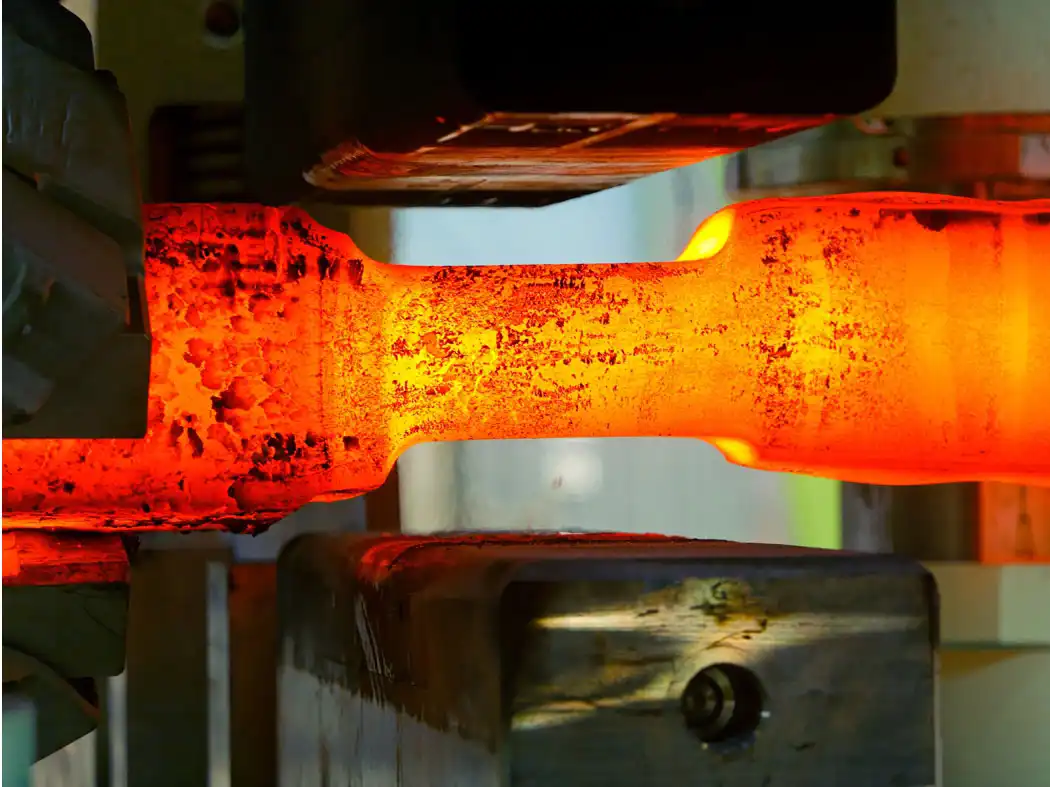
How Does Upset Forging Work in Aluminum Component Production?
The basic premise of upset forging is simple: A billet is placed between dies and crushed in the axial direction. As it gets shorter, its material flows out sideways, and the cross-sectional area increases. The end shape depends on the initial billet, the die geometry, the amount of deformation, the friction, the temperature, and the number of forging processes.
For aluminum alloys, the process window must be determined based on individual alloy and temper requirements. Aluminum is characterized by a low density and good formability; however, its deformation behavior is strongly affected by temperature and alloy composition. What works for one aluminum alloy may not be appropriate for another.
The beginning billet is important as well. The consistency of the filling of the die is dependent on the diameter, length, surface condition, and internal quality of the material. If the initial geometry is poorly chosen, too much barreling, folding, or underfilling or uneven deformation may ensue. So, in production, engineers may consequently employ preforms or numerous forging stages rather than try to get the whole shape in one operation.
This is particularly advantageous in upset forging, where there is a localized area of a part that requires additional material. Rather than cutting the section from a larger bar, forging can redistribute billet material prior to final machining.
Why Aluminum Parts Benefit From Upset Forging?
Improved Material Distribution and Mechanical Performance
One reason manufacturers look into upset forging is the material structure is changed by plastic deformation. The aluminum is not just chopped to shape in forging but is deformed in a controlled way. This can lead to a more favorable grain flow and less machining to achieve the basic component shape, depending on the alloy and process conditions.
Grain flow is particularly critical when the orientation of the forged structure is along significant load routes in the final component. However, the qualities thus obtained should not be said to be superior in all directions automatically. Forging produces texture and directional behavior, and the forging process must be planned around the actual loading circumstances of the part.
The ultimate mechanical performance also depends on a future heat treatment if the specified aluminum alloy is heat treatable. Solution treatment, quenching, and aging may be employed in the production method for appropriate alloys. The forging operation must, however, be regarded as one step in a more complex series of material-processing steps and not as an independent operation.
Better Use of Material and Reduced Machining
The upset forging also improves the utilization of the material, because the process shapes the approximate geometry before the machining. This is of value for parts where a lot of material would have to be removed from bar stock.
For example, when a part has a bigger head or shoulder than the main shaft section, the use of a constant diameter bar might cause a huge amount of machining waste. In an upset operation, material can be moved toward the larger section required before the part begins finishing processes.
That does not mean that each forged component is inherently near-net form. Many aluminum forgings still require turning, milling, drilling, grinding, or other finishing procedures. In practical terms, forging can lower the quantity of material removed in those activities.
The impact can be substantial in high-volume production. More competitive cost per product can be achieved by using lower machining time, less raw material waste, and shorter finishing cycles.
Consistent Production for Repeated Components
Upset forging is also desirable when the same component has to be manufactured time and again. Once the billet size, die geometry, forging sequence, temperature window, and inspection requirements are validated, the process can be standardized for production.
This kind of repeatability is particularly valuable to industrial purchasers who need the same dimensions to be repeated batch to batch. It also makes documenting processes crucial. An experienced aluminum forging provider shall be able to provide a production batch with material specification, forging route, heat treatment, inspection records, and final dimensions.
What Happens to the Aluminum Microstructure During Forging?
Grain Flow, Deformation, and Recrystallization
Microstructure of an aluminum alloy depends on the amount and temperature of deformation. Plastic strain in upset forging alters the current grain structure and causes dislocations in the material. Recovery and recrystallization mechanisms are able to occur under adequate temperature and deformation conditions.
Dynamic recrystallization does not take place in all forja d'alumini operations. Its occurrence and significance depend on variables such as alloy composition, initial grain structure, deformation temperature, strain rate, and accumulated strain. In some processing processes, recovery or post-forging recrystallization may be more critical.
The practical purpose is not to generate the tiniest feasible grains. Rather, the producer has to establish a microstructure that is suitable for the alloy and the intended purpose. Undesirable fluctuations within the component can be caused by uncontrolled cooling, inappropriate thermal conditions, or excess deformation.
This is the reason why the microstructural evaluation might be part of the process development or qualification, especially for parts with severe mechanical requirements.
Texture and Directional Properties
Plastic deformation of aluminum alloys during aluminum forging can also lead to crystallographic texture. Some crystallographic orientations may become more favorable with rotation and deformation of grains. The deformation-induced texture may influence the mechanical behavior in numerous directions.
This is important where a forged item is under directed loading. Engineers should not assume that all attributes are the same in all directions but should evaluate the relationship between the forging direction and service loads.
The geometry and the sequence of deformation of the die can influence the material flow and the final texture. In production, control of these factors allows manufacturers to keep a consistent link between the geometry of the part and the structure of the material.
Precipitation and Heat Treatment
When handling heat-treatable aluminum alloys, forging and heat treatment must be considered jointly. The forging operation influences the distribution of alloying elements and the initial state for further precipitation treatment.
The solution treatment followed by quenching and artificial aging may be the heat-treatment procedure adopted after forging. The exact cycle depends on the alloy and the desired temper. Inappropriate thermal management for the required microstructure will lead to inferior mechanical characteristics.
That is why the specification of an aluminum forged part must not stop at dimensions. Material grade, temper, heat-treatment condition, mechanical specifications, and inspection standards may all need to be determined before manufacturing starts.
Which Process Parameters Control Upset Forging Quality?
Forging Temperature and Thermal Uniformity
Temperature is one of the most important variables in aluminum upset forging. The proper forging window depends on the alloy, billet condition, geometry, and deformation schedule. If heated out of the appropriate range, the flow behavior of the material may be altered and the chance of surface or internal flaws increased.
Uniform heating is not of less importance. If the surface and core of a billet have a large temperature difference, then the billet may not deform uniformly. Local changes in the flow stress can influence the die filling and the final dimensions.
Also, the temperature of the tooling should be considered, as it might draw heat from the workpiece during forming. Hence, the manufacturers need a regulated heating technique in production rather than the nominal furnace temperature.
Process qualification should involve temperature measurement, furnace calibration, transfer time, and cooling conditions. Recorded process data might be a crucial indication for critical parts that the forging route is still within the allowed operating window.
Strain Rate and Total Deformation
Strain rate tells us how fast the material is changing shape, and total deformation tells us how much the billet is changing shape. Both affect the material flow, the forging load, heat generation, and microstructural development.
A higher rate of deformation can raise the flow stress and produce more heat from plastic deformation. Depending on the alloy and temperature, this might have an influence on the local forging conditions. Forming that is too vigorous can potentially increase machine loads or make material flow more difficult to handle.
The overall reduction needs to be selected according to the needed shape and material reaction. More distortion is not always better. The method should offer adequate material flow to accomplish the specified structure and geometry without generation of excess forging loads or flaws.
These variables are generally established by process trials, technical calculations, and, where suitable, forming simulation for an forja d'alumini calendari de producció.
Friction, Lubrication, and Die Geometry
The flow behavior of the aluminum in upsetting is affected by the friction between the billet and die. If the friction is excessive or poorly regulated, the material can distort unevenly and exhibit severe barreling. Lubrication can aid in regulating friction and reducing sticking or excessive tool wear.
The lubricant itself must be compatible with the production method and the forging temperature. Application uniformity is critical, as differences in lubricant coverage can translate into differences in material flow.
The geometry is also significant. The way the material fills the tooling is influenced by fillet radii, transition areas, cavity dimensions, draft when appropriate, and the parting design. Sharp transitions raise local stress concentrations, whereas poorly constructed cavities lead to underfill or folding.
These conditions can be evaluated prior to manufacturing production tooling by computer-assisted engineering and finite element analysis. Simulation is not a substitute for physical validation, but it can help engineers in identifying potential filling problems and optimizing the forging sequence at an earlier stage of development.
What Parts Are Suitable for Upset Forging?
Upset forging is most suitable for geometries in which the required material distribution can be achieved through axial compression and lateral flow. Components with locally enlarged sections are common candidates because the process naturally moves material toward the areas that need additional cross-sectional area.
Examples can include shafts with enlarged ends, headed components, pins, connectors, coupling-related components, and other industrial parts with suitable axisymmetric or near-axisymmetric features. The exact suitability depends on the alloy, dimensions, tolerances, production quantity, and downstream machining requirements.
Part geometry should be reviewed before tooling is designed. A component with a very high length-to-diameter ratio, abrupt transitions, or complex non-axisymmetric features may require a different forging sequence or another manufacturing process.
This is also where engineering support can create a measurable difference. A supplier that reviews the drawing before quoting can identify whether the proposed billet size, forging direction, parting arrangement, and machining allowance are practical.
How Should Manufacturers Control Quality in Aluminum Forging?
Quality control should begin before the first forging operation. Material certificates should confirm the specified alloy and starting condition, while incoming material inspection can help verify dimensions and surface condition.
During production, manufacturers can monitor key parameters such as heating temperature, transfer time, forging sequence, die condition, and final dimensions. Depending on the application, mechanical testing, hardness testing, metallographic examination, dimensional inspection, or nondestructive testing may also be required.
Traceability is particularly important for industrial components supplied in batches. Material heat numbers, forging records, heat-treatment information, inspection results, and final inspection documentation should be linked where the customer specification requires it.
A capable supplier should also understand that quality is not limited to passing a final dimensional inspection. Stable process control is more valuable than discovering problems after a batch has already been produced.
How to Select an Aluminum Forging Supplier?
Choosing an aluminum forging supplier requires more than comparing unit prices. Buyers should evaluate whether the manufacturer has the equipment, engineering capability, tooling experience, inspection resources, and production capacity required for the component.
The supplier should be able to discuss the aluminum alloy, forging route, billet dimensions, die design, heat treatment, machining allowance, and inspection requirements in practical terms. Clear communication during drawing review can prevent costly tooling changes later.
For custom aluminum forging, it is also useful to confirm how the supplier manages prototypes and production transition. A reliable process should allow the first samples to be evaluated before full-scale manufacturing, with dimensional and material data used to confirm the production route.
At Shaanxi Welong Int'l Supply Chain Mgt Co., Ltd., custom metal components can be produced through forging, casting, and machining processes according to the project requirements. With ISO 9001:2015 and API-7-1 certifications, the company supports customers with engineering coordination, production management, quality control, and international delivery.
For buyers sourcing custom forged aluminum components, this integrated approach can simplify the transition from drawing review to finished parts. Material selection, forging, machining, inspection, and delivery can be coordinated as part of the same supply chain rather than managed as disconnected stages.
Conclusió
Upset forging is a practical manufacturing option for aluminum components that require controlled material redistribution, repeatable geometry, and efficient use of raw material. By compressing a billet along its axis, the process can move material toward larger sections while reducing the amount of stock that must later be removed through machining.
The final performance of an upset-forged component depends on much more than the forming operation itself. Aluminum alloy selection, billet condition, forging temperature, deformation level, strain rate, friction, die geometry, heat treatment, and inspection all contribute to the finished result. Microstructural changes such as grain deformation, recovery, recrystallization, and precipitation should therefore be evaluated according to the specific alloy and production route.
For manufacturers and industrial buyers, the most effective approach is to treat forja d'alumini as a complete manufacturing process rather than a single forming step. Careful design review, controlled production parameters, documented quality procedures, and appropriate post-forging operations can help achieve consistent parts for demanding applications. As lightweight aluminum components continue to be used across transportation, industrial equipment, energy, and other engineering sectors, a well-designed upset forging process can remain a valuable option for both performance and production efficiency.
Treballa amb un soci global fiable per a solucions metàl·liques personalitzades
Shaanxi Welong Int'l Supply Chain Mgt Co., Ltd., established in 2001, provides customized metal components for customers across multiple industries. The company supports forging, casting, and machining projects and works with international customers that require coordinated production and quality management.
With ISO 9001:2015 and API-7-1 certifications, Welong combines manufacturing coordination with engineering support, inspection management, and international supply-chain services. Its product capabilities include sand casting, investment casting, close die forging, and other customized metal manufacturing processes.
Per a una forja d'alumini project, the process can be evaluated from the initial drawing and material requirements through forging, finishing, inspection, and delivery. This helps customers address manufacturability and quality requirements before production begins and provides a more direct path from engineering requirements to finished components. For inquiries, please contact us at info@welongpost.com.
FAQ
1: What is upset forging in aluminum parts manufacturing?
Upset forging is a process that increases the cross-sectional area of a workpiece by compressing its length, resulting in stronger and more durable aluminum components.
2: How does upset forging improve the strength of aluminum parts?
Upset forging enhances strength by realigning the grain structure, eliminating internal defects, and creating a more homogeneous material composition.
3: What industries benefit from upset forged aluminum parts?
Industries such as automotive, aerospace, and construction benefit from the high-performance, lightweight components produced through upset forging.
4: How does upset forging affect the microstructure of aluminum alloys?
Upset forging refines grain structure, develops specific textures, and influences precipitation and phase transformations in aluminum alloys.
referències
1. Smith, JA (2018). Tècniques avançades en forja d'alumini. Journal of Materials Processing Technology, 256, 112-124.
2. Johnson, RB, i Thompson, LK (2019). Evolució microestructural en aliatges d'alumini forjats per recalcitrant. Ciència i Enginyeria de Materials: A, 742, 321-335.
3. Brown, EC, et al. (2020). Optimització dels paràmetres del procés en el forjat per recalcinació de components d'alumini. International Journal of Advanced Manufacturing Technology, 106(5), 2145-2160.
4. Davis, MR (2017). Manual de processos de forja d'alumini. CRC Press, Boca Raton, FL.
5. Lee, SH, i Kim, YT (2021). Desenvolupament de textures i anisotropia en aliatges d'alumini forjats per recalcitrant. Acta Materialia, 209, 116785.
6. Wilson, PD, et al. (2016). Influència del forjat per recalcinació en les propietats mecàniques dels aliatges d'alumini d'alta resistència. Materials & Design, 107, 527-539.

Share your inquiry, get the quotation accordingly!

Xina WELONG: el vostre soci de confiança en solucions metàl·liques

